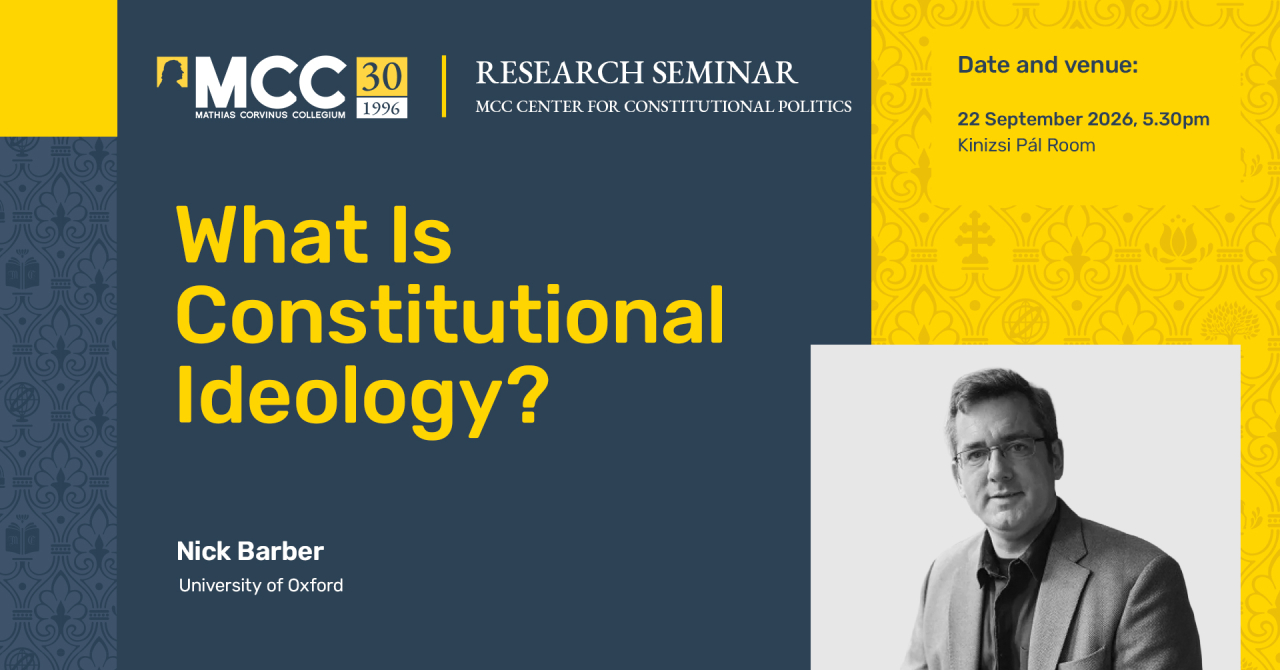
In this seminar, Nick Barber examines the idea of constitutional ideology and the role it plays in structuring constitutional discourse. He suggests that constitutional ideologies influence not only what can be argued within constitutional institutions, but also what can be argued only at reputational cost. Approaching constitutions as ideological frameworks allows us to see how individual rules form part of a broader worldview – one that participants in constitutional practice are, often implicitly, expected to accept.
The talk explores how this worldview, though rooted in legal rules, reaches beyond them. It shapes patterns of reasoning within institutions and informs how members of a political community understand authority, citizenship, attachment, and, ultimately, their own political identity. Special attention will be given to the relationship between rules and concepts, and to the different kinds of assumptions and claims that together make up a state’s constitutional ideology.
Guest speaker: Nick Barber is Professor of Constitutional Law and Theory in the Faculty of Law at University of Oxford. He specialises in public law, with a particular focus on constitutional law. He serves as Co-Director of the Programme for the Foundations of Law and Constitutional Government and is also Associate Dean (Research) in the Faculty.
----------------------------------------------
MCC students can earn credit for actively participating in the event, provided they read the required chapters and paper(s) and prepare three questions for the Q&A session of the research seminar.
Questions related to the required reading must be submitted to Kálmán Pócza at pocza.kalman@mcc.hu by 11:00 PM on 22 September 2026.
Required Reading: Please contact Kálmán Pócza to obtain the electronic version of the paper.
Submission Deadline: 22 September 2026, 11:00 PM
Previous Research Seminars:
- Martin Loughlin (London School of Economics): Against Constitutionalism
- Nigel Biggar (Univeristy of Oxford): What’s Wrong with Rights?
- Asanga Welikala (University of Edinburgh): The Common Good and Comparative Constitutional Laws
- John Wyatt (Faraday Institute Cambridge): Right To Die?
- John Larkin (former Attorney General for Northern Ireland): Judicial Power in the United Kingdom
- Michael Freeden (University of Oxford): Concealed Silences and Inaudible Voices in Political Thinking
- Lee J. Strang (Ohio State University): Originalism's Promise: A Natural Law Account of the American Constitution
- Gonzalo Candia (Catholic University of Chile): The Constitution-Making Process in Chile 2019-2024
- Sergio Verdugo (IE University of Madrid): Is it time to abandon the theory of constituent power?
- Aileen Kavanagh (Trinity College Dublin): The Collaborative Constitution
- Scott L. Cummings (University of California Los Angeles): Lawyers and Movements
- Stephen Tierney (University of Edinburgh): Constituent Power in Federal States
- Stefan Auer (University of Hong Kong): European Disunion: Democracy, Sovereignty and the Politics of Emergency
- Dieter Grimm (Wissenschaftskolleg Berlin): A View from the Bench: Personal Reflections on the Practice of Constitutional Adjudication
- Yuan Yi Zhu (University of Leiden): Revisiting the British Origins of the European Convention on Human Rights
- David Edmonds (University of Oxford): Effective Altruism: A Philosophical Reckoning
- Alexandre Lefebvre (University of Sydney): The Politics of the Good Life
- Anna Lukina (London School of Economics and Political Science): The Society of Angels and the Coordinative Function of Law
- Jacob Williams (University of Oxford): Post-liberalism: A Genealogy
- Natasha Wheatley (Princeton University): The Life and Death of States
- Frane Staničić (University of Zagreb): A View from the Bench: Frane Staničić
- Marc Bossuyt (University of Antwerp): A View from the Bench: Marc Bossuyt
- Jesse Smith (Ohio State University): The Need for a Conservative Paradigm in Social Sciences
- Randy E. Barnett (Georgetown University): Libertarianism for the Real World

 2026. szeptember 22. 17:30 - 19:00