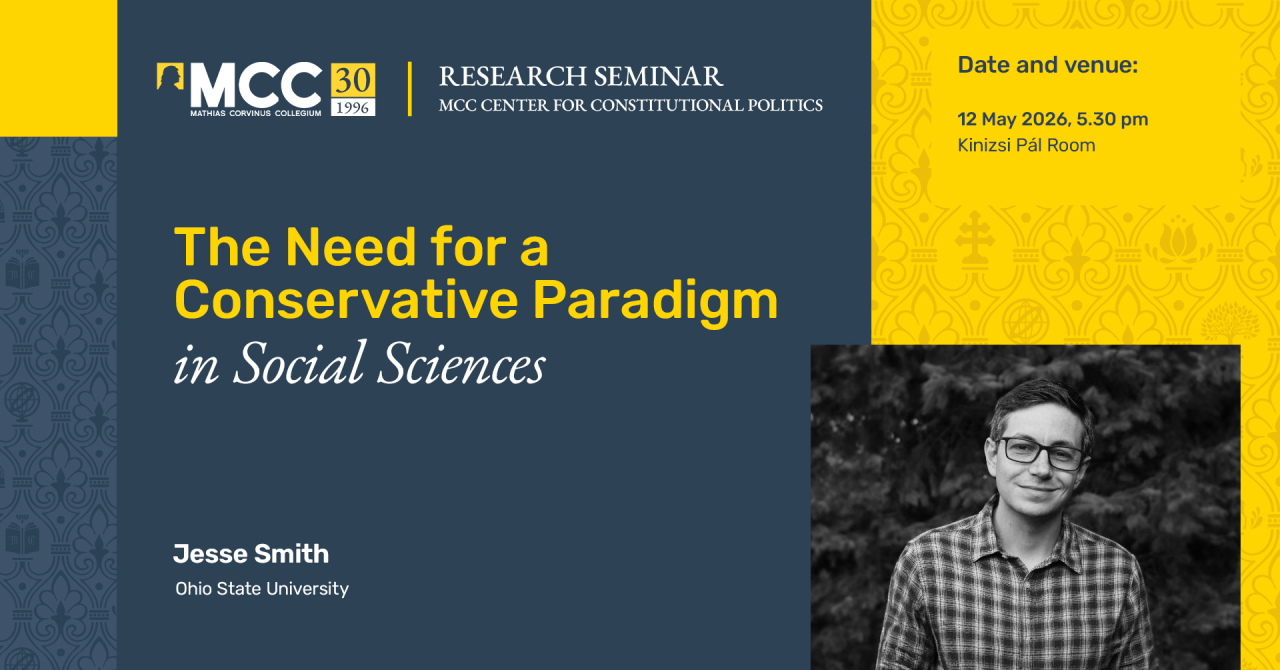
In an era of increasing ideological polarization, the social sciences face a growing crisis of „viewpoint diversity.” While the field has long been aware of its left-leaning imbalance, the question remains: does this lack of political variety actively undermine the validity of scientific knowledge? In this seminar, Jesse Smith argues that the current state of the discipline is not just a matter of representation, but a threat to the very epistemic functioning of social research.
Drawing on the classic insights of John Stuart Mill and Helen Longino, Smith moves beyond the simple call for „more voices” to examine the structural failures caused by ideological homogeneity. He distinguishes between mere activism and deep-seated „paradigmatic progressivism,” illustrating how certain research frameworks have become so dominant that they shield themselves from essential critique.
Against this backdrop, Smith advances a provocative central claim: the only way to restore scientific rigor is through the active development of a conservative paradigm. Far from turning science into a political tool, he argues that a conservative framework is a minimal necessary measure to ensure that social science remains objective and robust. Ultimately, this talk challenges the academic community to consider whether true scientific progress is possible without a deliberate return to ideological competition and the fostering of distinct, alternative worldviews.
Guest speaker: Jesse Smith is Assistant Professor at The Ohio State University’s Salmon P. Chase Center for Civics, Culture, and Society, specializing in the sociology of religion, political sociology, and social theory, with research interests spanning moral formation, family dynamics, and the role of theoretical pluralism in the social sciences.
The speaker will join the event online.
Date: 12 May 2026, 5:30 pm
Venue: Budapest, 1113 Tas vezér utca 3-7.
----------------------------------------------
MCC students can earn credit for actively participating in the event, provided they read the required chapters and paper(s) and prepare three questions for the Q&A session of the research seminar.
Questions related to the required reading must be submitted to Kálmán Pócza at pocza.kalman@mcc.hu by 11:00 PM on 10 May 2026.
Required Reading: Please contact Kálmán Pócza to obtain the electronic version of the paper.
Submission Deadline: 10 May 2026, 11:00 PM
Previous Research Seminars:
- Martin Loughlin (London School of Economics): Against Constitutionalism
- Nigel Biggar (Univeristy of Oxford): What’s Wrong with Rights?
- Asanga Welikala (University of Edinburgh): The Common Good and Comparative Constitutional Laws
- John Wyatt (Faraday Institute Cambridge): Right To Die?
- John Larkin (former Attorney General for Northern Ireland): Judicial Power in the United Kingdom
- Michael Freeden (University of Oxford): Concealed Silences and Inaudible Voices in Political Thinking
- Lee J. Strang (Ohio State University): Originalism's Promise: A Natural Law Account of the American Constitution
- Gonzalo Candia (Catholic University of Chile): The Constitution-Making Process in Chile 2019-2024
- Sergio Verdugo (IE University of Madrid): Is it time to abandon the theory of constituent power?
- Aileen Kavanagh (Trinity College Dublin): The Collaborative Constitution
- Scott L. Cummings (University of California Los Angeles): Lawyers and Movements
- Stephen Tierney (University of Edinburgh): Constituent Power in Federal States
- Stefan Auer (University of Hong Kong): European Disunion: Democracy, Sovereignty and the Politics of Emergency
- Dieter Grimm (Wissenschaftskolleg Berlin): A View from the Bench: Personal Reflections on the Practice of Constitutional Adjudication
- Yuan Yi Zhu (University of Leiden): Revisiting the British Origins of the European Convention on Human Rights
- David Edmonds (University of Oxford): Effective Altruism: A Philosophical Reckoning
- Alexandre Lefebvre (University of Sydney): The Politics of the Good Life
- Anna Lukina (London School of Economics and Political Science): The Society of Angels and the Coordinative Function of Law
- Jacob Williams (University of Oxford): Post-liberalism: A Genealogy
- Natasha Wheatley (Princeton University): The Life and Death of States
- Frane Staničić (University of Zagreb): A View from the Bench: Frane Staničić
- Marc Bossuyt (University of Antwerp): A View from the Bench: Marc Bossuyt

 May 12, 2026 at 5:30 PM - 7:30 PM