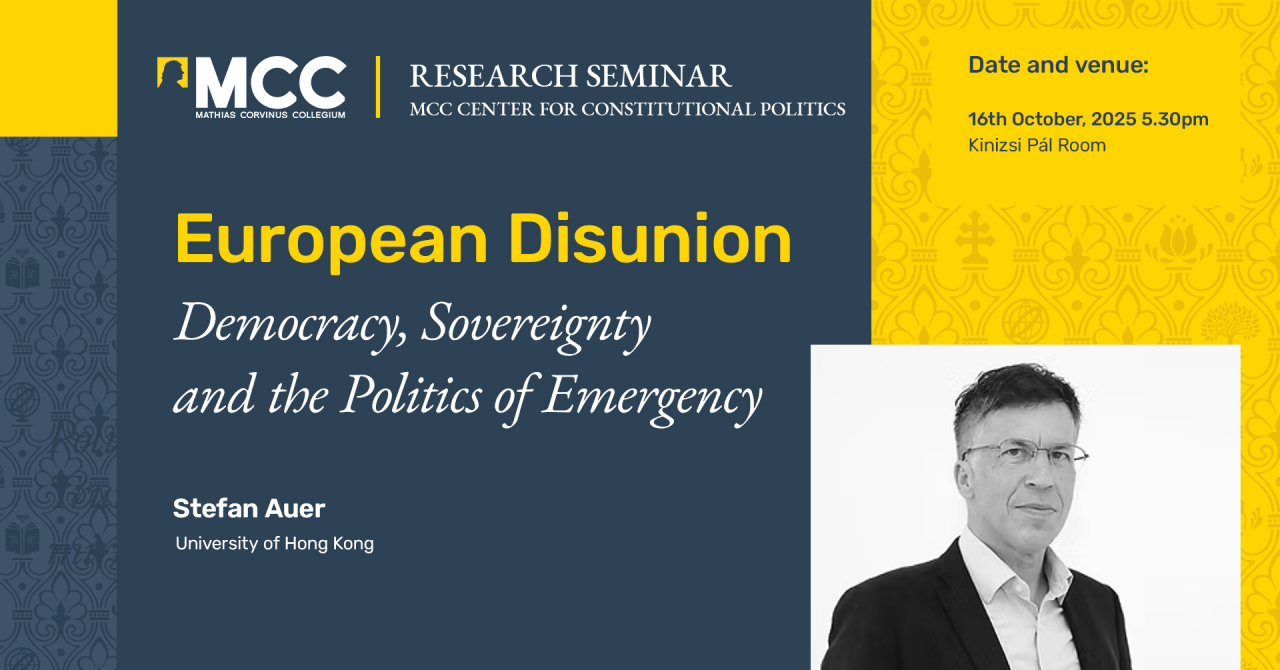
The European Union means many different things to its many peoples. In Germany, for example, the European project was conceived mainly as post-national, or even post-sovereign. In France, by contrast, President Emmanuel Macron has pursued the vision of a sovereign Europe; that is, an EU that would become a formidable geopolitical actor. Yet, instead, Europe has struggled to ascertain its values abroad and even domestically, facing a sovereignist rebellion from its newer member states, such as Hungary and Poland, and the departure of Britain. The eurozone crisis has undermined the EU's economic credentials, the refugee crisis its societal cohesion, the failure to stand up to Russia its sense of purpose, and the Covid-19 pandemic its credibility as a protector of European citizens. The key argument of this lecture is that the multiple crises of the European project are caused by one underlying factor: its bold attempt to overcome the age of nation-states. Left unchecked, supranational institutions tend to become ever more bureaucratic, eluding control of the people they are meant to serve. The logic of technocracy is thus pitted against the democratic impulse, which the European Union is supposed to embody. Democracy in Europe has suffered as a result.
Guest: Stefan Auer - Professor at the University of Hong Kong, specializing in political philosophy, comparative nationalism, and the crisis of the European project. He was twice awarded the title of Jean Monnet Chair in EU Studies.
Date: 16 October 2025, 5:30 pm
Venue: Budapest, 1113 Tas vezér utca 3-7., Kinizsi Pál Room
----------------------------------------------
MCC students can earn credit for actively participating in the event, provided they read the required chapters and paper(s) and prepare three questions for the Q&A session of the research seminar.
Questions related to the required reading must be submitted to Kálmán Pócza at pocza.kalman@mcc.hu by 11:00 PM on 14 October, 2025.
Required Reading: Please contact Kálmán Pócza to obtain the electronic version of the paper.
Submission Deadline: 14 October 2025, 11:00 PM
Previous Research Seminars
- Martin Loughlin (London School of Economics): Against Constitutionalism
- Nigel Biggar (Univeristy of Oxford): What’s Wrong with Rights?
- Asanga Welikala (University of Edinburgh): The Common Good and Comparative Constitutional Laws
- John Wyatt (Faraday Institute Cambridge): Right To Die?
- John Larkin (former Attorney General for Northern Ireland): Judicial Power in the United Kingdom
- Michael Freeden (University of Oxford): Concealed Silences and Inaudible Voices in Political Thinking
- Lee J. Strang (Ohio State University): Originalism's Promise: A Natural Law Account of the American Constitution
- Gonzalo Candia (Catholic University of Chile): The Constitution-Making Process in Chile 2019-2024
- Sergio Verdugo (IE University of Madrid): Is it time to abandon the theory of constituent power?
- Aileen Kavanagh (Trinity College Dublin): The Collaborative Constitution
- Scott L. Cummings (University of California Los Angeles): Lawyers and Movements
- Stephen Tierney (University of Edinburgh): Constituent Power in Federal States

 October 16, 2025 at 5:30 PM - 7:30 PM
 Twitter