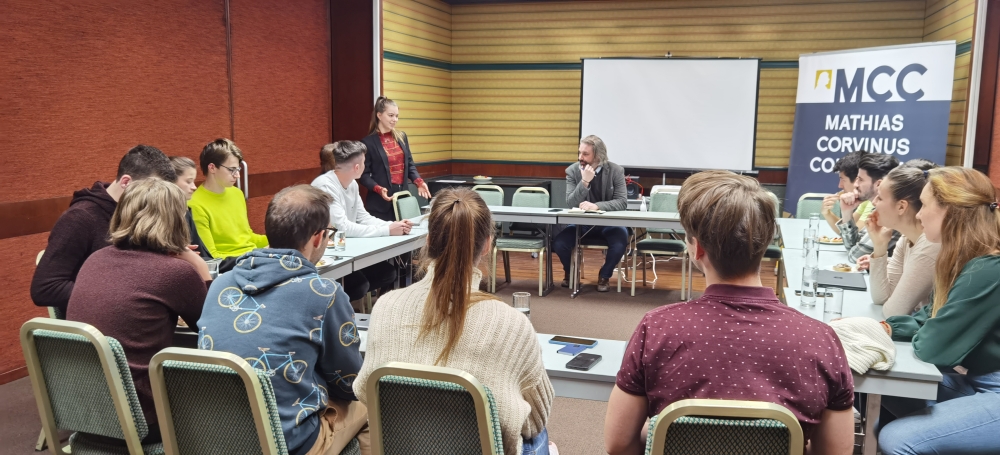
Participants of the Leadership Academy invited Calum T. M. Nicolson, fellow researcher of Mathias Corvinus Collegium and Danube Institute for an interactive seminar on societal changes through social media.
There was a need for better understanding that went beyond mainstream discussion, a need for listening to great minds about how algorithms influence our behaviour, how society as a whole copes with turbulent changes and how we as individuals can be more conscious about our media consumption.
To engage with the provided problem—taking personal interests into consideration—the participants discussed what aspects of the problem they would prefer to elaborate on before the seminar.
The most popular questions were about whose responsibility is the regulation and policy making for social media, the polarisation effect and radicalisation, the impact on art and culture and vice versa, politics and social media and fake news. The preferences were communicated toward Calum, and he prepared for the seminar accordingly. This way the discussion was fully interactive, and everyone could find his or her own learning point.
The key takeaways of the problem, according to Calum, was that by constantly browsing our social media feed and letting ourselves be influenced by the algorithms we do not connect with each other anymore. Our relationships are weakening, and in times of change, when a society is weak, people get more susceptible to ideas. As the Tsunami only destroys shallow waters and the coast, so do dangerous ideas destroy weak societies. To maintain stability and keep our society strong, we have to put relations before narrations, connect with each other and be good listeners. Go deeper than some unnecessary comment fighting on our Facebook feed, and understand that we are no longer the customers of social media companies but their products along with our data.
- Rozenberszki Zsófia írása