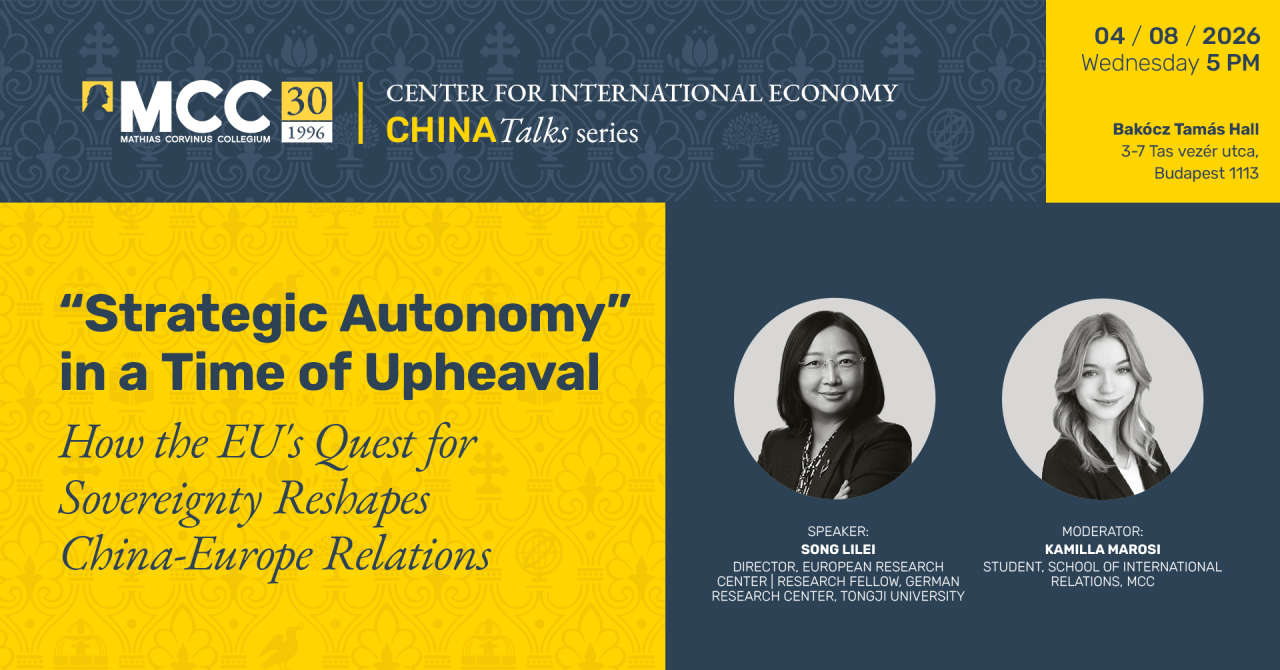
Speaker: Song Lilei, Director, European Research Center | Research Fellow, German Research Center, Tongji University
Moderator: Kamilla Marosi, Student, School of International Relations, MCC
The European Union's pursuit of strategic autonomy is increasingly constrained by three interlocking structural challenges: entrenched security dependency on the United States, intensifying political fragmentation among member states, and a conspicuous leadership vacuum at the strategic core. This widening gulf between ambition and reality has left the EU oscillating between contradictory impulses amid intensifying China-US competition—eager to reduce transatlantic reliance yet unwilling to bear the costs of decoupling; designating China as a "systemic rival" while remaining unable to forgo the strategic value of its market. Against this backdrop, China-Europe relations have entered a complex new phase, characterized by the deep entanglement of cooperation and competition and the uneasy coexistence of interdependence with risk management. Understanding the EU's internal dilemmas is thus essential to anticipating the future trajectory of this pivotal relationship.
Song Lilei, Professor at the School of Political Science and International Relations, Director of the European Research Center, and Research Fellow at the German Research Center of Tongji University. She has published over 40 articles in Chinese and English academic journals, two monographs on EU diplomacy, and four edited volumes on China-EU relations. She served as academic staff for the EMECW LOT14 Program at Vrije Universiteit Brussel, Belgium (2010), and as a Postdoctoral Fellow at Corvinus University of Budapest under the Erasmus Mundus GATE program (2014–2015). She was an academic visitor at the University of Oxford (2015–2016), a Think Visegrad Non-V4 Expert Fellow at the Institute of Foreign Affairs and Trade in Hungary (2022), and a visiting fellow at MCC (2022).
Research Areas: China-Europe relations, EU foreign policy.
-----------------------------------------------------------------------------------------------------------------------------
Az Európai Unió stratégiai autonómia iránti törekvését egyre inkább három, egymással összekapcsolódó strukturális kihívás korlátozza. Ezek: az Egyesült Államoktól való mélyen gyökerező biztonsági függőség, a tagállamok közötti egyre fokozódó politikai széttagoltság, valamint az Unió vezetésében tapasztalható vákuum. A téves politikai ambíciók és a valóság közötti egyre növekvő szakadék miatt pedig az EU, a Kína és az Egyesült Államok közötti fokozódó verseny közepette ellentmondásos impulzusok között ingadozik, várva, hogy csökkentse a transzatlanti függőséget, de nem hajlandó viselni ennek költségeit. Emellett pedig Kínát „rendszerszintű riválisnak” minősíti, miközben gazdaságilag képtelen lemondani a kínai piac stratégiai értékéről. Ebben az értelemben pedig a Kína és Európa közötti kapcsolatok egy komplex új szakaszba léptek, amelyet az együttműködés és a verseny mély összefonódása, valamint a kölcsönös függőség és a kockázatkezelés kényelmetlen együttélése jellemez.
 2026. április 8. 17:00 - 18:00