
It shows how globalization once focused mainly on efficiency and economic growth, but is now increasingly shaped by national security concerns and strategic rivalry, particularly between the United States and China. Through examples such as the semiconductor industry, the Huawei case, and recent geopolitical conflicts like the war in Ukraine and tensions around Taiwan, the lecture explains how supply chains, technology, and trade routes have turned into instruments of global power. Ultimately, it highlights how the world economy is shifting from a purely globalized system toward a more fragmented and geopolitically driven order.
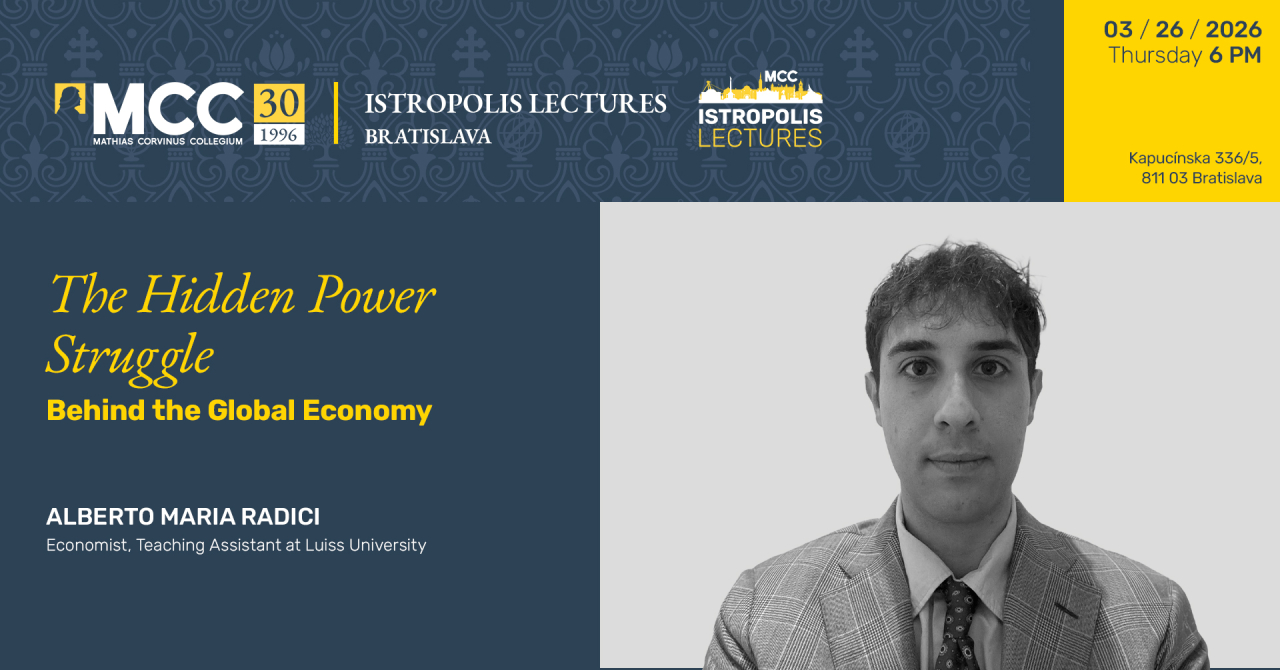
At the invitation of Mathias Corvinus Collegium, economist Alberto Maria Radici is visiting Bratislava. The lecture explores how global value chains, foreign direct investment (FDI), and technological competition have become key tools in today’s geopolitical power struggle.
 2026. március 26. 18:00 - 19:30
Kapucínska 336/5, 811 03 Bratislava-Staré Mesto, Szlovákia

Kapucínska 336/5, 811 03 Bratislava-Staré Mesto, Szlovákia
Megosztás:


Előző esemény
2026. március 26.
Miskolci képzési központ
Ki viszi tovább a lángot? Avagy miért van szükségünk gyermekekre?
Következő esemény

2026. március 27.
Egri képzési központ