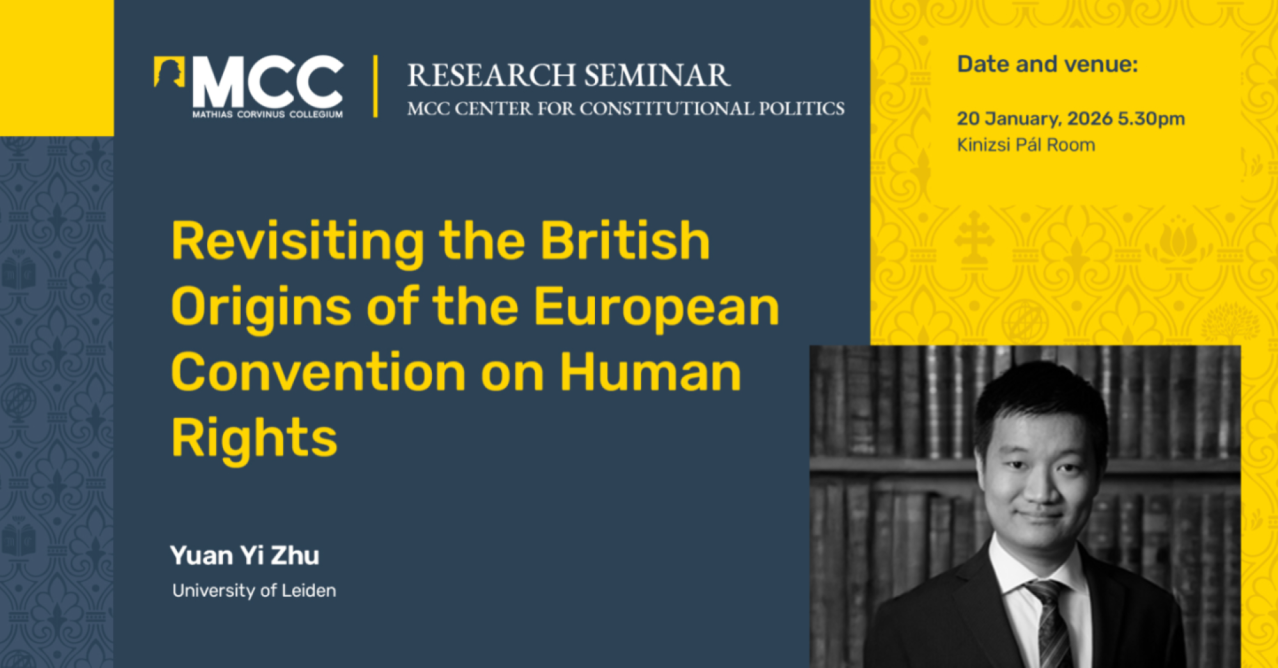
The discussion will examine the Attlee government’s original conception of the Convention – often imagined as a limited safeguard against totalitarianism rather than a foundation for a far-reaching supranational court. The seminar will investigate the historical divergence between these initial intentions and the subsequent expansion of the Strasbourg Court’s authority. Key questions to be addressed include: To what extent does the modern ECHR reflect the assumptions of its British drafters? And does the claim of a “British legacy” still offer a valid basis for the UK’s commitment to the Convention, or does it overlook how significantly the system has evolved over the past seventy-five years?
The session will delve into the evolution of the ECHR from a safeguard against totalitarianism into a broad legal order capable of reshaping domestic law. Participants will discuss whether the historical narrative of British authorship can still sustain the UK’s commitment to the Convention, or if the divergence between 1950 and the present day requires a fundamental rethinking of this relationship.
Guest: Yuan Yi Zhu – Assistant Professor at Leiden University, specializing in UK and Commonwealth constitutional law, judicial power, and public law history.
Date: 10 January 2026, 5:30 pm
Venue: Budapest, 1113 Tas vezér utca 3-7., Kinizsi Pál Room
----------------------------------------------
MCC students can earn credit for actively participating in the event, provided they read the required chapters and paper(s) and prepare three questions for the Q&A session of the research seminar.
Questions related to the required reading must be submitted to Kálmán Pócza at pocza.kalman@mcc.hu by 11:00 PM on 18 January, 2026.
Required Reading: Please contact Kálmán Pócza to obtain the electronic version of the paper.
Submission Deadline: 18 January 2026, 11:00 PM
Previous Research Seminars:
- Martin Loughlin (London School of Economics): Against Constitutionalism
- Nigel Biggar (Univeristy of Oxford): What’s Wrong with Rights?
- Asanga Welikala (University of Edinburgh): The Common Good and Comparative Constitutional Laws
- John Wyatt (Faraday Institute Cambridge): Right To Die?
- John Larkin (former Attorney General for Northern Ireland): Judicial Power in the United Kingdom
- Michael Freeden (University of Oxford): Concealed Silences and Inaudible Voices in Political Thinking
- Lee J. Strang (Ohio State University): Originalism's Promise: A Natural Law Account of the American Constitution
- Gonzalo Candia (Catholic University of Chile): The Constitution-Making Process in Chile 2019-2024
- Sergio Verdugo (IE University of Madrid): Is it time to abandon the theory of constituent power?
- Aileen Kavanagh (Trinity College Dublin): The Collaborative Constitution
- Scott L. Cummings (University of California Los Angeles): Lawyers and Movements
- Stephen Tierney (University of Edinburgh): Constituent Power in Federal States
- Stefan Auer (University of Hong Kong): European Disunion: Democracy, Sovereignty and the Politics of Emergency
- Dieter Grimm (Wissenschaftskolleg Berlin): A View from the Bench: Personal Reflections on the Practice of Constitutional Adjudication
- Yuan Yi Zhu (University of Leiden): Revisiting the British Origins of the European Convention on Human Rights

 January 20, 2026 at 5:30 PM - 7:30 PM
 Twitter