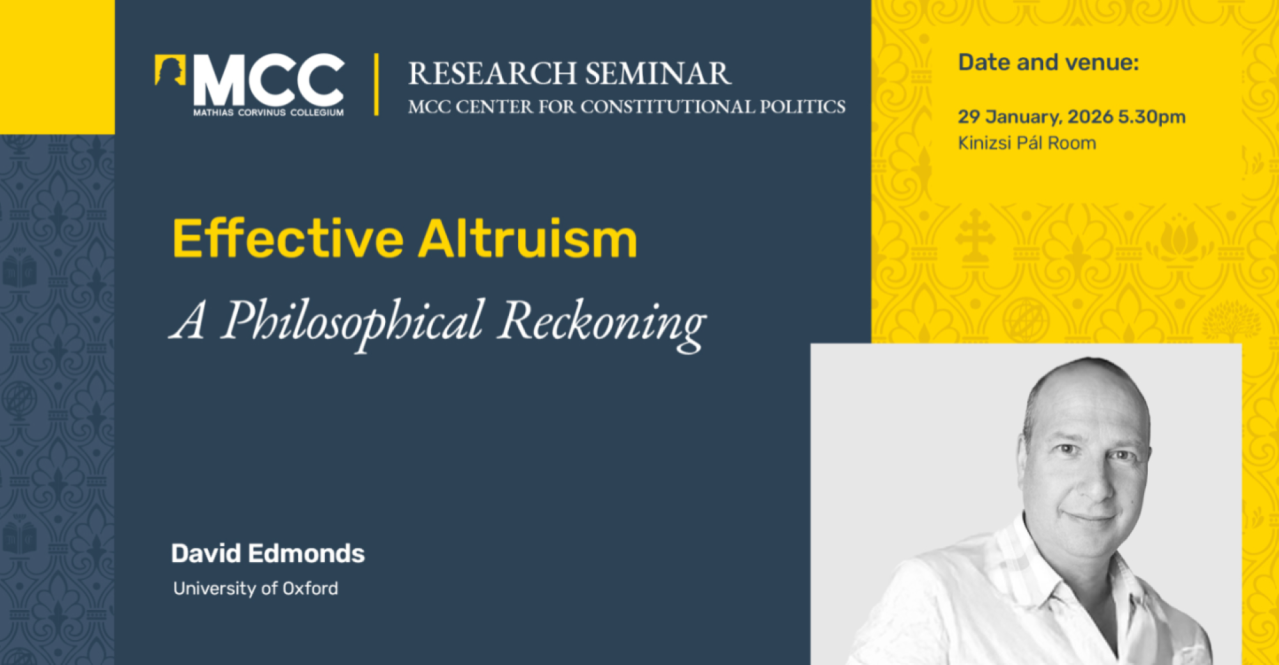
Moral duties toward distant strangers remain deeply contested. Peter Singer’s “drowning child” thought experiment argued that ignoring global poverty is no less troubling than refusing to save a nearby child to protect one’s shoes. This simple claim reshaped debates on charitable giving and inspired the Effective Altruism movement, while also provoking sharp criticism for overlooking structural causes of suffering. In Death in a Shallow Pond, David Edmonds traces the origins and influence of Singer’s idea, showing how it challenged traditional views of responsibility and transformed approaches to philanthropy. Yet, like many bold ethical projects, it has struggled to balance compelling moral appeals with real-world complexities. The research seminar takes up these debates and returns to a simple but pressing question: can a thought experiment still shape how we understand our responsibilities in a world where so much suffering could be avoided? Edmonds argues that, for all the criticism, the Shallow Pond continues to challenge us to face what we owe to others—and to consider what it really means to step in when we are able to help.
Guest: David Edmonds – Senior Research Associate at the University of Oxford’s Uehiro Centre for Practical Ethics and BBC World Service radio feature maker, specializing in practical ethics and moral philosophy.
Date: 29 January 2026, 5:30 pm
Venue: Budapest, 1113 Tas vezér utca 3-7., Kinizsi Pál Room
----------------------------------------------
MCC students can earn credit for actively participating in the event, provided they read the required chapters and paper(s) and prepare three questions for the Q&A session of the research seminar.
Questions related to the required reading must be submitted to Kálmán Pócza at pocza.kalman@mcc.hu by 11:00 PM on 27 January, 2026.
Required Reading: Please contact Kálmán Pócza to obtain the electronic version of the paper.
Submission Deadline: 27 January 2026, 11:00 PM
Previous Research Seminars:
- Martin Loughlin (London School of Economics): Against Constitutionalism
- Nigel Biggar (Univeristy of Oxford): What’s Wrong with Rights?
- Asanga Welikala (University of Edinburgh): The Common Good and Comparative Constitutional Laws
- John Wyatt (Faraday Institute Cambridge): Right To Die?
- John Larkin (former Attorney General for Northern Ireland): Judicial Power in the United Kingdom
- Michael Freeden (University of Oxford): Concealed Silences and Inaudible Voices in Political Thinking
- Lee J. Strang (Ohio State University): Originalism's Promise: A Natural Law Account of the American Constitution
- Gonzalo Candia (Catholic University of Chile): The Constitution-Making Process in Chile 2019-2024
- Sergio Verdugo (IE University of Madrid): Is it time to abandon the theory of constituent power?
- Aileen Kavanagh (Trinity College Dublin): The Collaborative Constitution
- Scott L. Cummings (University of California Los Angeles): Lawyers and Movements
- Stephen Tierney (University of Edinburgh): Constituent Power in Federal States
- Stefan Auer (University of Hong Kong): European Disunion: Democracy, Sovereignty and the Politics of Emergency
- Dieter Grimm (Wissenschaftskolleg Berlin): A View from the Bench: Personal Reflections on the Practice of Constitutional Adjudication
- Yuan Yi Zhu (University of Leiden): Revisiting the British Origins of the European Convention on Human Rights

 January 29, 2026 at 5:30 PM - 7:30 PM
 Twitter