Following the Second World War, the United States gradually abandoned its earlier, so-called hemispheric foreign policy and, by the mid-20th century, shifted toward a Europe-centered, transatlantic orientation. With the rise of the Soviet Union, the U.S. found itself facing a military power of equal standing, which—aiming to prevent another global conflict—prompted a more active role in international affairs. In 1947, the Marshall Plan was introduced, followed by the establishment of the NATO military alliance in 1949. During the Cold War, Europe became the clear focal point of U.S. foreign policy, resulting in a significant security dependence of the continent on the United States. After the end of the Cold War, NATO did not diminish in importance; on the contrary, it began expanding eastward—a move that many experts already considered controversial at the time. The creation of the European Union further deepened this duality: while Europe increasingly evolved into a self-regulating economic community, its security dependence remained intact. Amid the accelerating globalization of the 2000s, NATO’s scope of activity expanded significantly, with partnerships extending into Asia and Africa. By the early 2020s, however, it had become increasingly clear that the system had grown imbalanced, with its focus often drifting away from the most pressing challenges.
Following his return to the presidency, Donald Trump outlined a number of ambitious goals, among which the reconsideration of transatlantic relations stands out as particularly significant. From the outset, Trump made it clear that the United States could no longer be expected to bear the primary burden of Europe’s defense. Currently, the U.S. covers approximately 16% of NATO’s total defense spending, while also shouldering a substantial share of Europe’s security operations and logistical infrastructure.
The next guest of the Budapest Lectures series will be Peter Slezkine, Director of the Russia Program at the Stimson Center. He will address key questions such as: what new geopolitical challenges may come to define NATO’s agenda, how a more balanced and sustainable framework of cooperation can be developed, and what the future holds for Europe’s security policy.
The event is open to the public but requires prior registration.

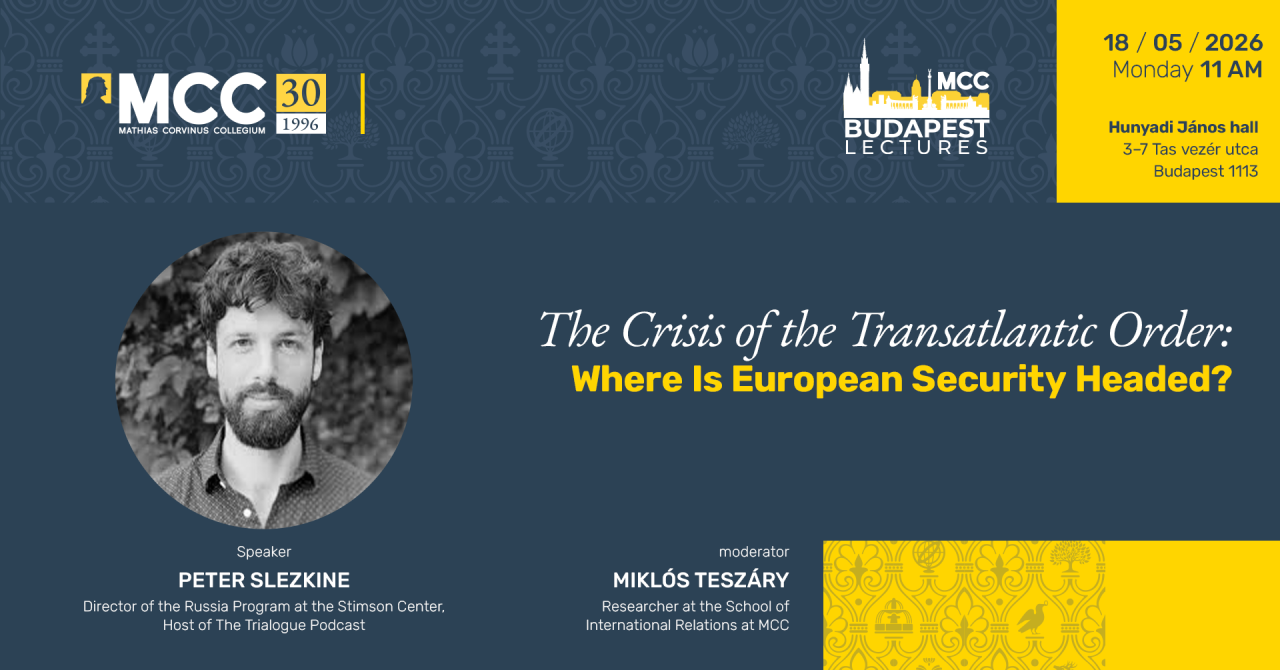
 May 18, 2026 at 11:00 AM - 12:00 PM