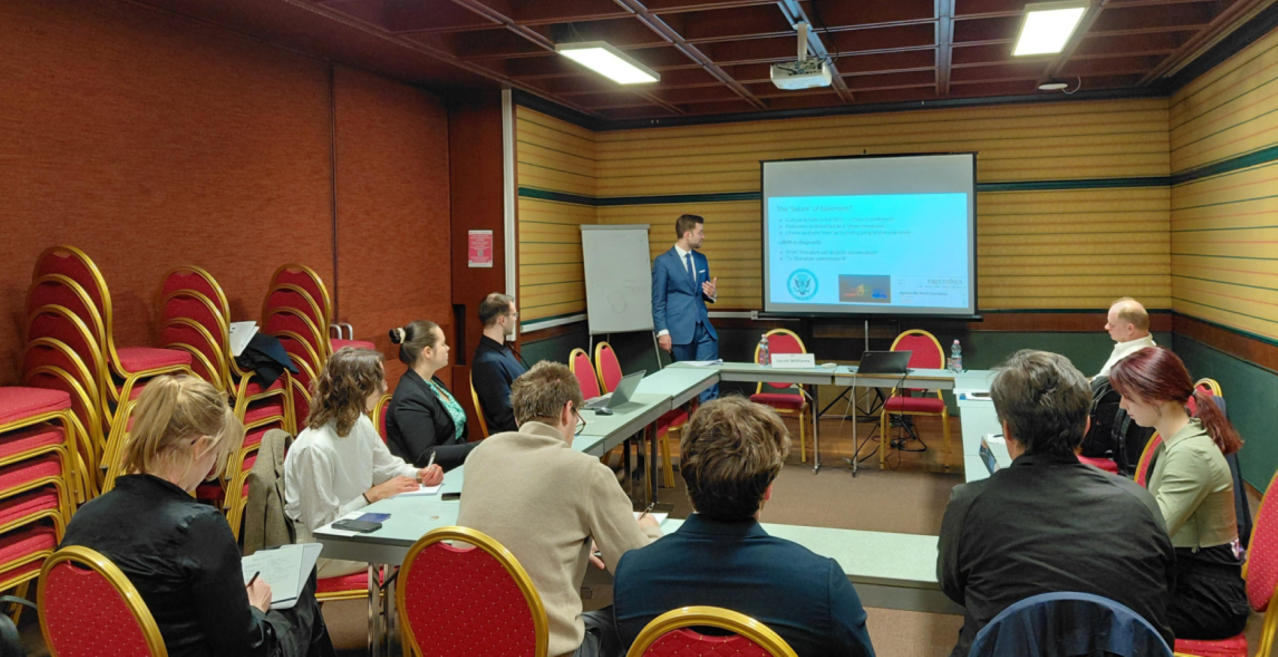
On April 9, 2026, MCC's Center for Constitutional Politics hosted Jacob Williams, a recent doctoral graduate in Political Theory from the University of Oxford’s Department of Politics and International Relations, for a research seminar examining the intellectual foundations of postliberalism. The event brought together students and scholars to explore one of the most complex areas of contemporary political thought.
Presenting an intellectual genealogy of postliberalism, Williams argued that it is not a single, unified ideology but a diverse set of responses to the perceived crisis of liberalism. Tracing its development from theological debates in the 1970s to the contemporary American New Right, he highlighted how both its meaning and political objectives have evolved over time.
Williams identified three key strands within postliberal thought. The first, associated with John Milbank and described as the Politics of Virtue, emphasizes communal life over individualism, though critics see it as too accommodating to liberal frameworks. The second, the Politics of Exile, takes a more metaphysical approach and is often viewed as overly pessimistic about the role of religious communities in secular society. The third, termed the Politics of Enmity, reflects a more confrontational strand within the contemporary American Right, advocating for the active use of state power, and is frequently criticized for its coercive implications.
The discussion also addressed the conceptual boundaries of postliberalism, including the role of Natural Law and the limits of coercive policy-making. Williams concluded that a precise understanding of these traditions is essential to grasp the broader intellectual and political stakes surrounding current responses to the crisis of modernity.