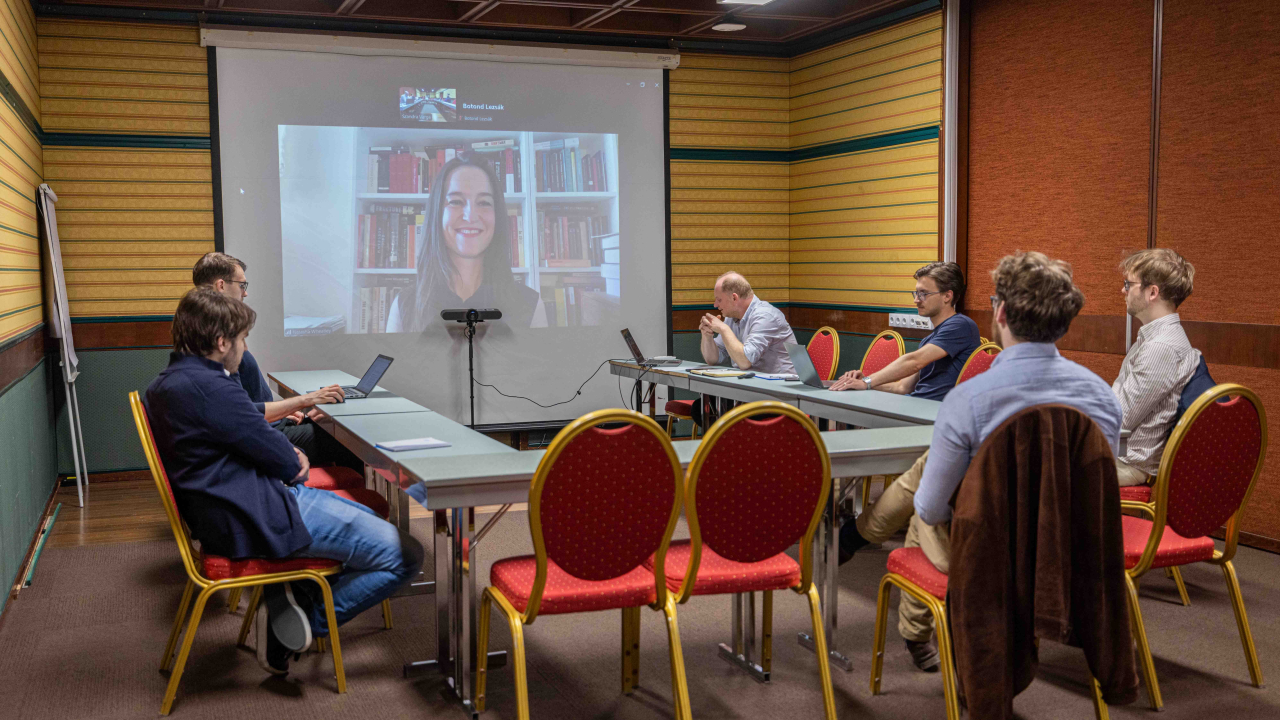
On 16 April 2026, MCC's Center for Constitutional Politics hosted Natasha Wheatley, Associate Professor of History at Princeton University, for an online lecture exploring the emergence of modern sovereignty. Drawing on her book The Life and Death of States, Wheatley challenged the assumption that today’s world of nearly 200 nation states represents a natural or inevitable development. Instead, she argued that the current international order is rooted in legal experimentation that followed the collapse of the Habsburg Empire.
In her lecture, Wheatley presented the Habsburg Empire not as a failed and outdated political structure, but as a laboratory of modern legal thought. The empire’s linguistic and cultural diversity necessitated innovative legal solutions, many of which continue to shape contemporary understandings of statehood. Central to this intellectual development were figures such as Georg Jellinek, who conceptualized the state as a unity of territory, population, and sovereignty, and Hans Kelsen, who defined law as an abstract system of norms. Their theories sought to impose constitutional coherence on a polity characterized by profound diversity, including the coexistence of twelve languages within a single imperial framework.
A particularly thought-provoking element of the discussion addressed the notions of state “death” and “revival.” Wheatley explained that following the empire’s dissolution in 1918, successor states such as Hungary and Czechoslovakia did not define themselves as entirely new entities. Rather, they framed their existence as a continuation of prior statehood emerging from a dormant or suspended condition. This concept of “suspended sovereignty” later gained global relevance, influencing legal arguments during decolonization processes. In countries such as India and Algeria, jurists similarly maintained that colonial rule had obscured, but not extinguished, pre-existing sovereignty.
The lecture concluded with the insight that sovereignty should not be understood as a fixed or timeless attribute, but as the result of ongoing legal and intellectual interpretation. Wheatley’s analysis highlighted the role of influential legal thinkers who sought to create stability through the tools of logic and law amid periods of historical upheaval. By revisiting the legacy of Central Europe’s legal innovations, the event offered valuable perspectives on the foundations of the modern international order and shed light on the deeper origins of contemporary legal tensions.