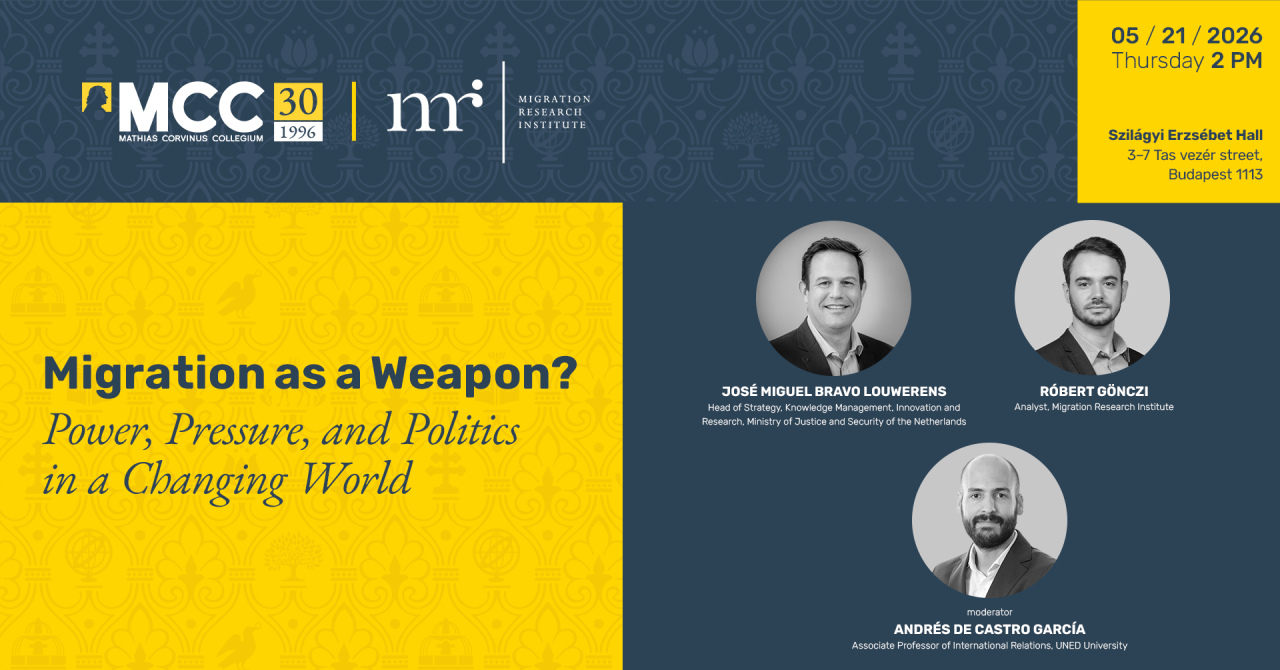
This event brings together leading experts to explore how and why migration has become embedded in hybrid conflict strategies. Drawing on real-world cases – from Belarus and Russia to Morocco – the discussion will examine how states use migration as a coercive instrument, and how targeted countries respond under pressure.
What makes this phenomenon particularly complex is the intersection of security, politics, and values. Liberal democracies often face difficult trade-offs between border protection and humanitarian commitments, while responses at the EU level remain fragmented and reactive.
The panel will also introduce a realist perspective on migration, combining structural and domestic-level analysis to better understand state behaviour in an increasingly competitive and unstable international system.
Programme:
14:00–14:20: Opening remarks and keynote:
Weaponisation of Migration – A Realist Account
14:20–15:30: Panel discussion: Migration as a tool of coercion
- What does it mean to “weaponise” migration?
- Why has this tactic become more frequent since 2015?
- Case studies: Belarus-Poland, Russia-Finland, Morocco-Spain
- How effective is migration coercion in practice?
- Are European responses strategic or reactive?
- The role of domestic politics and public opinion in shaping responses
Speakers and participants:
José Miguel Bravo Louwerens
(Head of Strategy, Knowledge Management, Innovation and Research, Ministry of Justice and Security of the Netherlands)
Róbert Gönczi
(Analyst, Migration Research Institute)
Moderator:
Andrés de Castro García
(Associate Professor of International Relations, UNED University)
 May 21, 2026 at 2:00 PM - 3:30 PM