What do ideology, public image, political rhetoric, and fashion have in common? Far more than one might expect. These questions were explored at the international scientific conference Fashions in Politics, organized by MCC’s Center for Political Science, where Hungarian and international scholars examined how power, communication, identity, and visual representation increasingly shape one another in modern public life.
The conference opened with remarks by Gábor Csepregi, advisor to MCC’s Leadership Academy, who highlighted that concepts such as sovereignty, defense, identity, and political messaging are deeply connected to clothing and symbolic appearance. This was followed by a video message from John Fonte, who spoke about the growing ideological tensions shaping the 21st century and the influential role of dominant worldviews and social mentalities in contemporary political discourse.
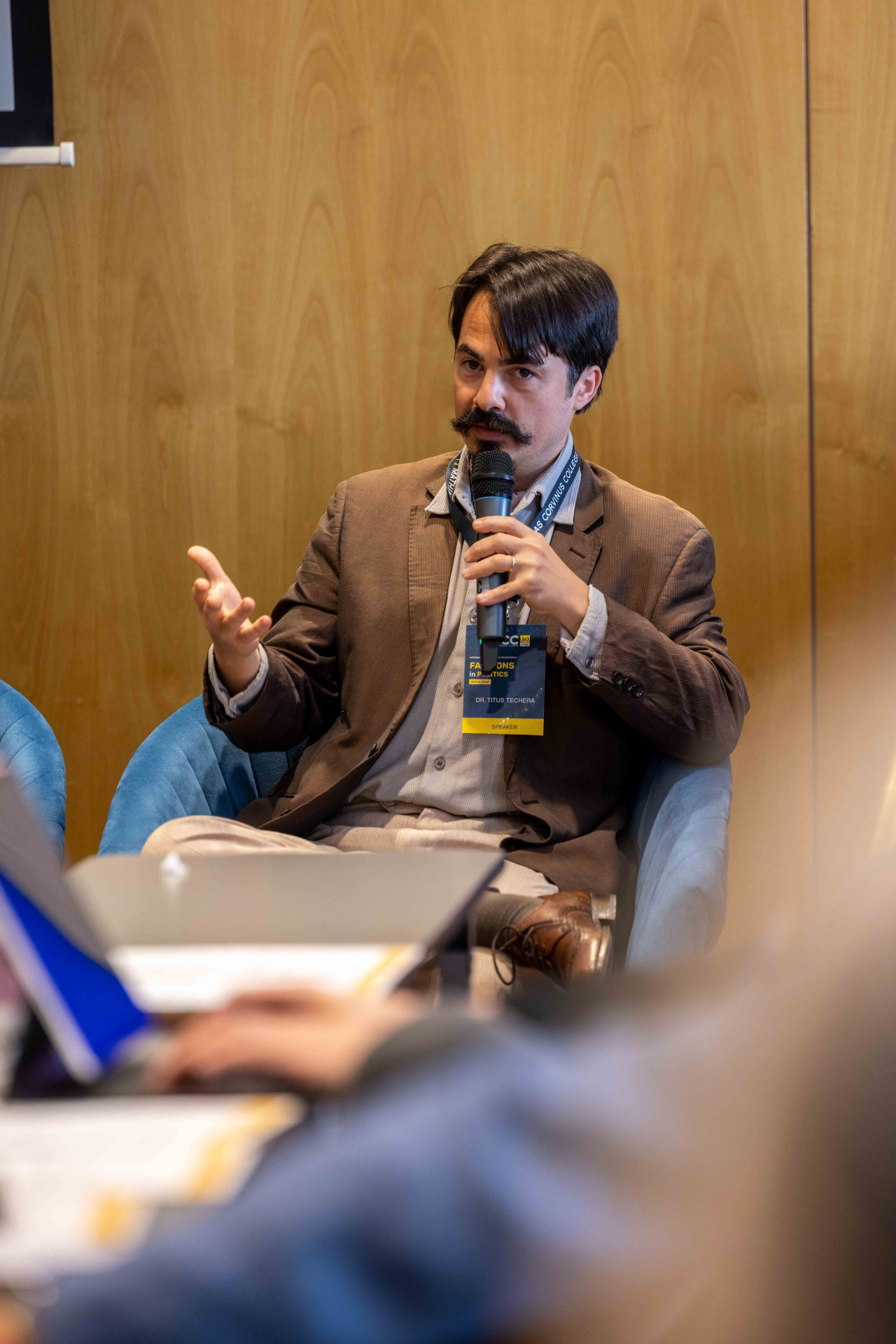
The first panel focused on the changing relevance of political ideologies and began with a keynote lecture by Chantal Delsol, who reflected on the constantly evolving cultural meaning of “fashion.” During the discussion, Jeremy Friedman and Titus Țecheră argued that major historical ideologies such as socialism, conservatism, and liberalism have rarely functioned as true mass ideologies in practice, despite their historical influence.
The conference continued with a keynote address by former diplomat Petr Drulák, who described the contemporary spirit of the age as one increasingly shaped by hubris and the imitation of behavioral patterns. Together with Marco Malaguti and Márton Ugrósdy, the discussion examined broader geopolitical questions surrounding power, sovereignty, and stability in an evolving international environment.
In the afternoon sessions, the focus shifted toward political communication and rhetoric. Introduced by Petra Aczél, the panel featuring Bruce I. Newman and Paul Baines explored the growing importance of marketing and communication strategies in politics. Speakers emphasized that voters increasingly respond to authentic, direct, and emotionally credible communication, noting that public trust today is often shaped as much by perceived authenticity as by professional competence.
The conference concluded with a discussion on symbolism, aesthetics, and political appearance, introduced by Dominik Pietzcker. The panel highlighted how personalization, symbolism, and politics have become closely interconnected in contemporary public life. Todd P. Newman noted that political clothing and aesthetics often serve as visual reflections of cultural identity and historical tradition, while participants agreed that the aesthetics of power frequently communicate leadership qualities and value systems long before words are spoken.
One of the conference’s central conclusions was that while fashionable trends may seem like surface level phenomena, their analysis offers important insight into the deeper dynamics of political culture, public communication, and decision making.