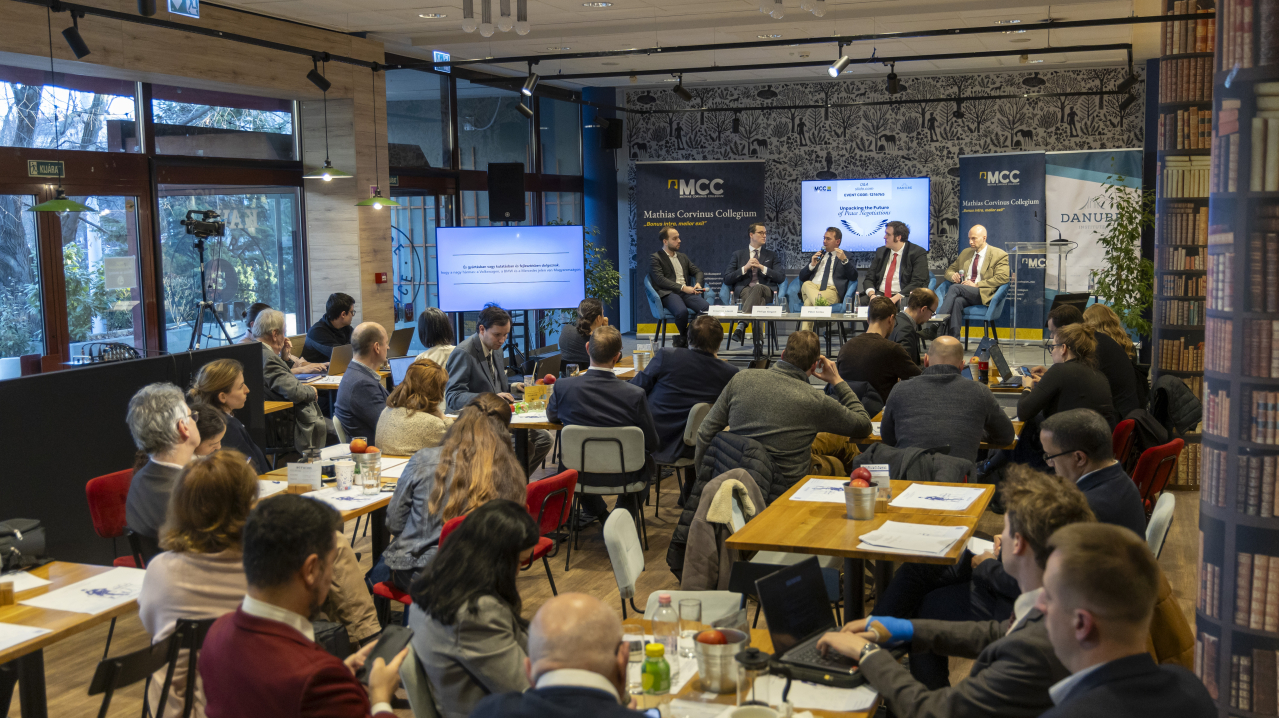
MCC and the Danube Institute hosted a conference titled Unpacking the Future of Peace Negotiations to examine the prospects for ending the war in Ukraine and the broader strategic implications for Europe, including energy policy, enlargement, and transatlantic relations.
In his opening remarks, Péter Lánczi, Deputy Director General for Professional and International Affairs reflected on the human cost of the conflict. “For four years now, a tragic war has been ongoing in which Ukrainians have fought bravely and preserved their statehood, yet the daily losses and suffering are gradually eroding this,” he said, noting that the impact of the war is also directly felt in Hungary, particularly through the experiences of the Hungarian community in Transcarpathia. István Kiss, Executive Director of the Danube Institute emphasized that Hungarians have also lost their lives on the front line and highlighted that the conference, organized in cooperation with the Danube Institute, seeks to explore realistic pathways toward peace and Hungary’s potential role in supporting them.
The first panel, Real Peace: Budapest as Europe’s Honest Broker, focused on energy security and diplomacy. Márton Ugrósdy. Head of the Office of the Political Director stressed that ensuring affordable energy remains a primary national interest and that Hungary, due to its geographic position, must keep all available options open while seeking diversification opportunities. He reiterated that Hungary is ready to host peace talks, although the political will to negotiate must come from the parties involved. István Kiss pointed to ongoing Russian gas supplies and improving Hungarian American economic ties, arguing that the window for meaningful negotiations may be narrowing. Richárd Schenk, Research Fellow at MCC Brussels described Ukraine’s potential EU accession as an immense undertaking, particularly in the context of an active war.
The second panel addressed enlargement, financial responsibility, and the evolving transatlantic relationship. Ralph Schoellhammer, Head of the Center for Applied History and IR Theory underlined the long term nature of geopolitical transformation, stating, “These things will take time,” and noted divisions within the European Union over the continuation of the war. Sean Nottoli, Visiting Fellow at the Danube Institute argued that Washington is adopting a more realist approach toward Central Europe and emphasized the importance of active participation in political debate. Péter Szitás, Deputy Director of Research at the Danube Institute highlighted the role of personal political relationships and raised security concerns linked to enlargement, while Philipp Siegert, Deputy Director of Research at MCC Brussels described the current geopolitical moment as a decisive stage for Europe.
The discussion underscored that Ukraine’s EU ambitions, Europe’s energy strategy, and the future of peace negotiations are deeply interconnected issues that will shape the continent’s strategic direction in the years ahead.