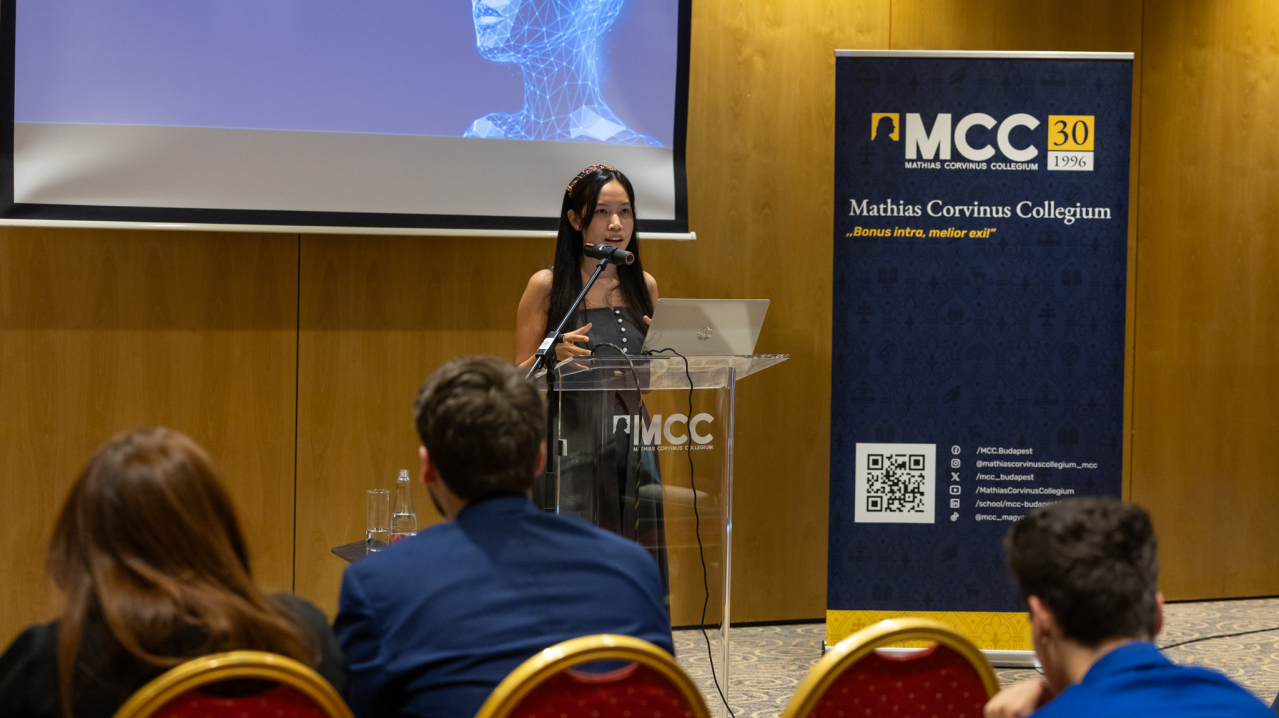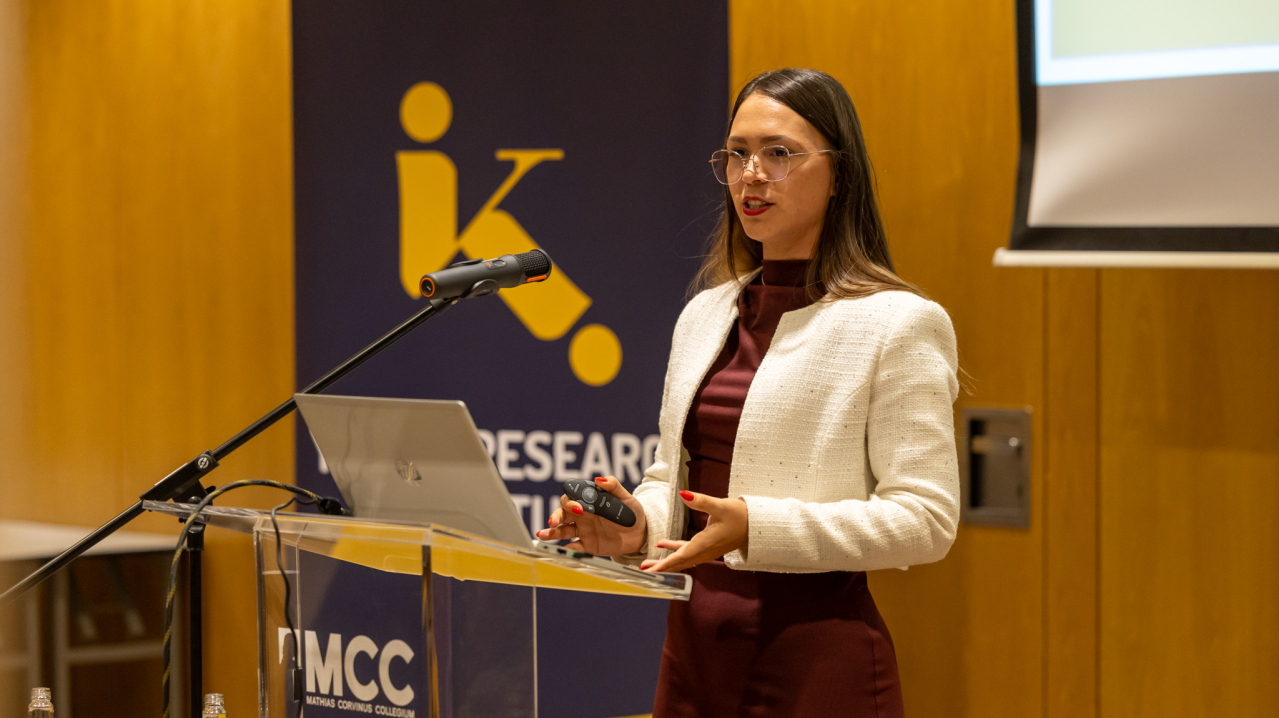
MCC's Youth Research Institute hosted the third edition of its annual international Emerging Voices conference, bringing together young researchers from around the world to present their latest findings on youth related issues and contemporary social challenges. Held on May 14, the conference welcomed six international and two Hungarian speakers who explored some of the most pressing questions affecting younger generations today, including social change, digitalization, and the growing role of artificial intelligence.
In her opening remarks, Georgina Kiss-Kozma, Deputy Director of the Youth Research Institute, emphasized that youth as a life stage is undergoing significant structural transformation. She highlighted how global crises, loneliness, and the expansion of digital culture increasingly shape young people’s experiences and social relationships, while also placing pressure on traditional community bonds.
The international panel featured researchers from Italy, the United Kingdom, Spain, and Indonesia. Marta Visioli of the Università Cattolica del Sacro Cuore examined how Italian youth reinterpret political participation in the context of contemporary social crises, highlighting the growing importance of intersectional activism and digital mobilization. Liam Miles of the University of Northampton explored how young people in Birmingham perceive poverty, insecurity, and political exclusion, particularly in connection with urban redevelopment and social inequality.
Erin Wingerter, a doctoral researcher at the University of Navarra, analyzed fertility intentions in Spain and argued that fairness within relationships and changing social norms increasingly influence decisions about family formation. Epsilandri Septyarini of Sarjanawiyata Tamansiswa University focused on how Indonesian youth navigate questions of justice, empathy, and morality in an increasingly digital public sphere shaped by social media and online accountability.
The mixed panel explored the relationship between technology, education, and personal development. Aurelio Fernández of the University of Navarra presented research on how smartphone use affects face to face interactions and contributes to loneliness and “digital alienation” in everyday life. Roland Tardi, Head of Academia at MCC, examined the growing influence of algorithms on public discourse, highlighting the role of echo chambers and filter bubbles in shaping online communication and social polarization.
Meyly Kheng, a doctoral researcher at the University of Debrecen, discussed how international educational experiences and informal learning environments shape language acquisition and self directed learning among globally mobile students. Enikő Szakos, researcher at MCC’s Learning Institute and Head of the Fináczy Ernő Educational Research Centre at Ludovika University of Public Service, explored how artificial intelligence is transforming education and challenging traditional forms of assessment, while also creating new opportunities for personalized learning and critical thinking development.
The conference concluded with a professional evaluation of the presentations, during which reviewers particularly highlighted the work of Erin Wingerter for her research on fertility intentions and generational responses to social and economic uncertainty. The event closed with an interactive workshop moderated by researcher Krisztián Tóth, where participants discussed the challenges facing young researchers and the international trends shaping youth studies today.