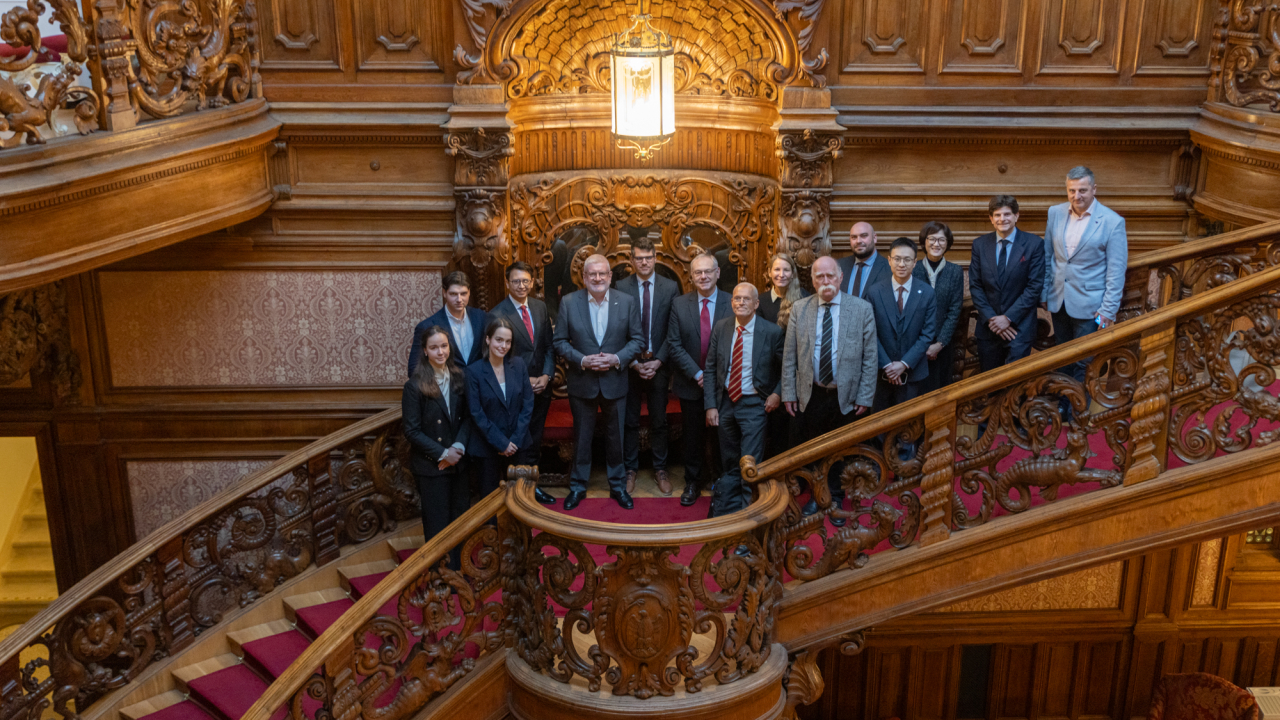
“Dominion over nature and its resources must go hand in hand with responsibility and humility, and the development of the international legal order must promote this” – it was stated at the tenth international scientific conference titled Climate Judgements, organized by the MCC Center for International Law. The conference examined climate-related decisions of international courts, as well as the legal, economic, and social impacts of climate change.
Renowned speakers from nearly every region of the world and from diverse legal cultures participated in the Climate Judgements conference organized by MCC's Center for International Law. The fully booked event was prompted by recent decisions of international courts concerning state responsibility in relation to climate change. At the same time, the conference also discussed the broader impacts of climate change on international law and on business and social life.
In his opening address, Lénárd Sándor, Head of School of Law as well as of the Center for International Law emphasized that although climate change is a modern phenomenon, the story of Prometheus from Greek mythology still resonates today: dominion over nature and its resources must be accompanied by responsibility and humility. In her speech, State Secretary for Environmental Affairs Anikó Raisz focused on the practical implementation of climate policy objectives at both the domestic and international levels. She also highlighted how states, business actors, and representatives of academia can cooperate in this regard.
The first panel of the conference examined international judicial decisions. Mitch Fifield, former Australian Ambassador to the United Nations, analyzed the advisory opinion of the International Court of Justice, emphasizing the importance of dialogue with the United Nations General Assembly. Professor Andreas Ziegler, professor of international law, noted in relation to the judgment against Switzerland delivered by the European Court of Human Rights that the ruling represents a significant departure from the Court’s previous case law. At the same time, he pointed out that, based on earlier decisions of international courts, the direction of the judgment had nevertheless been foreseeable. Professor Tomoko Ishikawa of Nagoya University reviewed the impact of climate-related decisions on international economic dispute settlement.
Presentations in the second panel focused on the wide-ranging consequences of climate change. Professor Davor Vidas of the Fridtjof Nansen Institute stressed that in the Anthropocene era, the rules and interpretation of international law must evolve in order to preserve their original function, namely, the protection of statehood and legal certainty. Carla Chavich, Deputy CEO of Compass Lexecon, and Zhixing Fu, representative of the China International Economic and Trade Arbitration Commission in Vienna, analyzed the impact on the costs of commercial arbitration, while Stjepan Gadžo from the University of Rijeka examined the issue of carbon taxation.
The presentations in the closing panel reviewed the role of criminal law in environmental protection and climate change. Professor Péter Kovács, international law professor and former judge of both international and constitutional courts, together with international lawyer Micheel Herz, explored the scope and development of international criminal courts. Meanwhile, Professor Rafał Wielki of University of Opole examined the challenges facing national criminal law.
The fully attended international conference was a fitting celebration of the anniversary of the Center for International Law Workshop and remained faithful to MCC’s core academic mission: to introduce its students to creative, forward-looking, and timely ideas of global significance that are also of particular importance to Hungary.