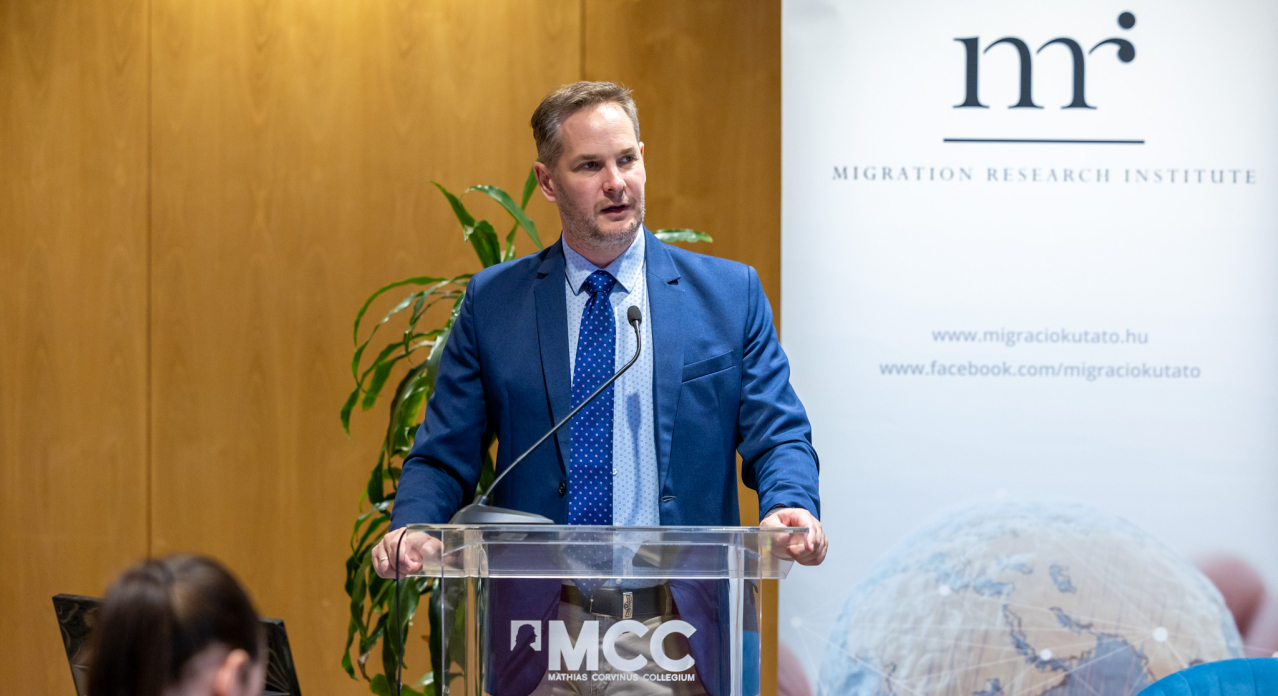
Migration trends and challenges across Latin America took center stage at a panel discussion moderated by Viktor Marsai, Executive Director of the Migration Research Institute. The event brought together Gustavo da Frota Simões, Professor at the Brazilian Army Command and General Staff College, Gabriella Thomázy, Assistant Professor at Ludovika University of Public Service, and Máté Balogh, Researcher at the Migration Research Institute, to explore the forces shaping migration across the region.
Gustavo da Frota Simões examined the changing migration landscape in Latin America through the lens of the Brazilian migration paradox. He explained that while Brazil has historically been a country shaped by immigration, particularly from Portugal, migration patterns have shifted significantly over time. Following the economic difficulties of the 1980s, many Brazilians left for the United States and Western Europe. In the following decades, however, Brazil increasingly became a destination for migrants arriving from countries such as Venezuela, Haiti, and Cuba.
According to Simões, Brazil today occupies a unique position as both a destination and a transit country. Many Cuban migrants, for example, have used Brazil as a temporary stop on their journey to the United States. At the same time, Brazilian society maintains mixed attitudes toward migration. He also pointed out that Brazil lacks a centralized migration authority, with responsibilities divided among several ministries. While obtaining residence permits, work authorization, or refugee status is relatively straightforward, the country has struggled to develop comprehensive integration policies for newcomers.
Simões devoted particular attention to the Venezuelan migration crisis, noting that nearly seven million Venezuelans have remained in Latin America and the Caribbean. In response, Brazil launched a large-scale operation involving the Civil House, the Ministry of Defense, and a military task force. The initiative sought to provide humanitarian assistance, ease pressure on the heavily affected border region of Roraima, and relocate migrants voluntarily to other parts of the country through an "interiorization" program.
Gabriella Thomázy provided a broader regional perspective, highlighting Chile as one of the most attractive destinations in Latin America due to its relatively high wages. She also noted that deteriorating security conditions in Ecuador have made the country less appealing for Venezuelan migrants and discussed how political developments in Chile have contributed to changing migration flows in recent years.
Focusing on migration toward the United States, Máté Balogh examined the complexities of U.S. migration policy. He noted that many asylum seekers spend years waiting for court hearings after submitting their applications through official channels. During this period, many establish jobs, communities, and social ties, making eventual deportation increasingly difficult from both a political and social perspective. Balogh also argued that border management and enforcement have improved significantly under the Trump administration.
The discussion offered valuable insights into the migration dynamics shaping Latin America today, highlighting the region's interconnected challenges, policy responses, and evolving migration patterns.